


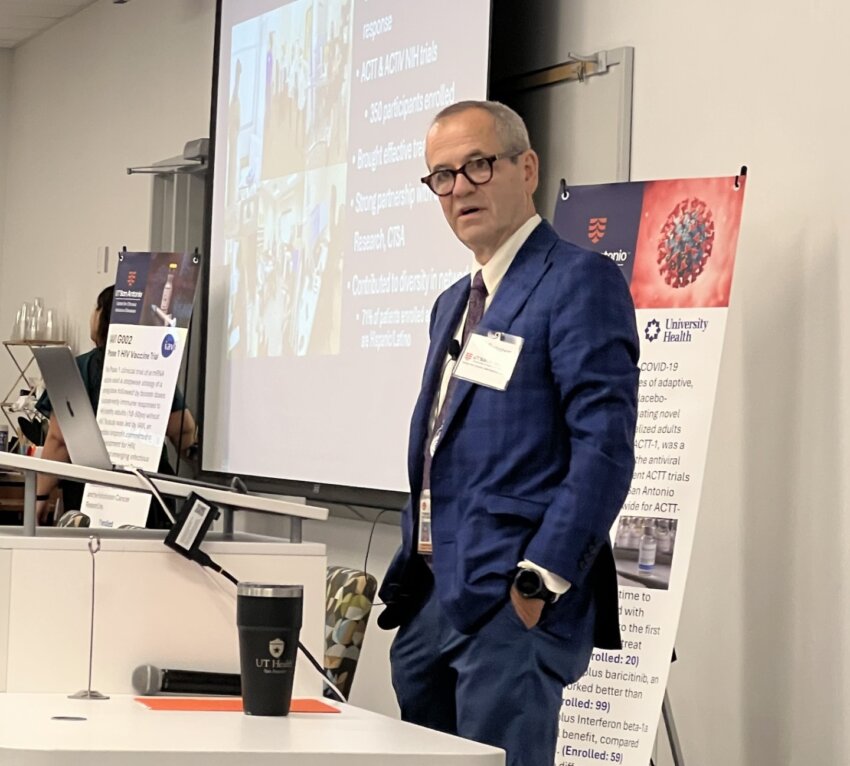
The University of Texas at San Antonio marked the launch of its new Center for Chronic Infectious Diseases on Nov. 14 with an inaugural symposium highlighting research on post-acute sequelae of SARS-CoV-2 infection (long COVID), human immunodeficiency virus (HIV), tuberculosis (TB) and endemic fungal infections. The event brought together researchers, local collaborators and a patient–advocate advisory board whose members emphasized that understanding the lived experience of chronic infection is essential to shaping effective research.
The Center for Chronic Infectious Diseases aims to unite cross-disciplinary teams committed to advancing infectious disease research. Led by director Barbara Taylor, MD, professor in the Division of Infectious Diseases, and co-director Thomas Patterson, MD, chair of the Department of Medicine and professor in the Division of Infectious Diseases, the center promotes collaboration to address the health needs of South Texas and to inform care globally.
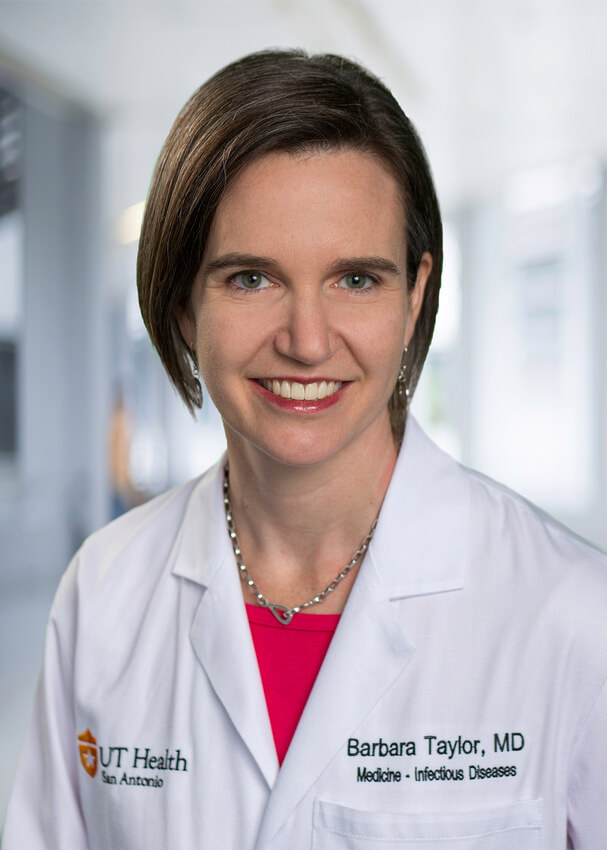
University Health — a prominent academic medical center with two teaching hospitals and a network of outpatient centers serving San Antonio and Bexar County — is embedded within the leadership structure of the center, with the involvement of Anna Taranova, MD, NS, CCRP, vice president for health innovation at University Health System. The Center for Chronic Infectious Diseases is also partnering with Texas Biomedical Research Institute, San Antonio Metropolitan Health District and Columbia University Division of Infectious Diseases.
Learning in real time with long COVID
After the symposium’s opening remarks, Patterson shared new findings from RECOVER, a national, four-year study of long COVID. Data from RECOVER described common symptom clusters in those experiencing long COVID and a research index to support rigorous future research. RECOVER defined trajectories of symptoms over time and has supported enrollment in dozens of treatment studies. Because RECOVER tracks participants over several years, researchers can examine how behaviors and symptoms evolve over time.
“That’s the power of RECOVER,” Patterson said. “We can actually look at how it changes.”
Advisory board shares lived experience
A central part of the symposium was a panel discussion with the center’s patient advisory board members, whose perspectives ground the work in real-world experience. Panelist Medea Morris described the shifting nature of her long COVID symptoms.
“I feel like I can speak on behalf of people because I’ve had so many different symptoms,” she said. “But I also understand that I can’t speak for everybody. Other people have experiences that we don’t.”
Another board member, living with HIV, described the promise of new therapies.
“Before this, I never really took any medicine. And now I take medicine every day, forever. Things like long-acting injections are really exciting,” the board member said.
When asked about clinical trial participation, Morris added, “Unless you’ve gone through what I’ve gone through, you don’t understand what it’s like to be willing to try anything once, if it helps. And if it doesn’t, then [you] learn something from it.”
Next-generation HIV prevention and treatment
Results of the Positive Links for Youth study, led by Taylor and Taranova, demonstrate the power of targeted community-focused design in improving HIV care for individuals ages 16 to 29. A mobile app designed with input from this community helped users manage medications, appointments and lab results, leading to viral suppression for 80% of app users compared to 44% of nonusers.
“For this age range, which is particularly difficult to engage, that is impressive,” Taylor said.
The center is also one of four global sites testing a first-in-human mRNA prime-boost HIV vaccine with the International AIDS Vaccine Initiative. Early results show 80% of participants produced strong immune responses, a promising step toward future HIV vaccine strategies.
Emerging threats and therapeutic advances
Nathan Wiederhold, PharmD, director of the university’s Fungus Testing Laboratory, highlighted rising threats in fungal disease, including the expanding range of coccidioidomycosis, or Valley Fever, and the spread of Trichophyton indotineae, a hyper-virulent dermatophyte fungus appearing across the U.S. and Canada. The lab, a national reference center established in 1985, has tested more than 2,000 investigational antifungals and is evaluating several promising phase 3 treatments.
During the 2023 fungal meningitis outbreak linked to medical tourism in Matamoros, Mexico, the lab showed that the antifungal fosmanogepix had excellent in-vitro activity against the species complex Fusarium solani, informing CDC emergency-use recommendations.
“This is an example of how the work we do in the laboratory is now translating to clinical outcomes,” Wiederhold said.
Additional research highlights
Chukwuemeka Okafor, PhD, MPH, assistant professor in the Division of Infectious Diseases, presented RECOVER data on healthcare utilization, symptom clusters and substance use patterns among people with long COVID.
“Because we follow people for years, we can actually see how these patterns change,” Okafor said.
José Cadena Zuluaga, MD, professor in the Division of Infectious Diseases, discussed research on tuberculosis vaccination uptake, gaps in TB diagnosis and treatments for MRSA, an infection caused by a type of staph bacteria, and C. difficile, a bacterium that causes an infection of the colon. Zuluaga’s Veterans Affairs collaborations have supported studies on surgical-site infection prevention, hand hygiene, environmental disinfection and diabetic foot osteomyelitis therapies, including a national 800-patient trial that is nearing completion. His work also includes evaluating six-week TB prevention regimens, rapid interferon-gamma assays and a multicenter comparison of doxycycline versus penicillin for syphilis amid nationwide penicillin shortages.
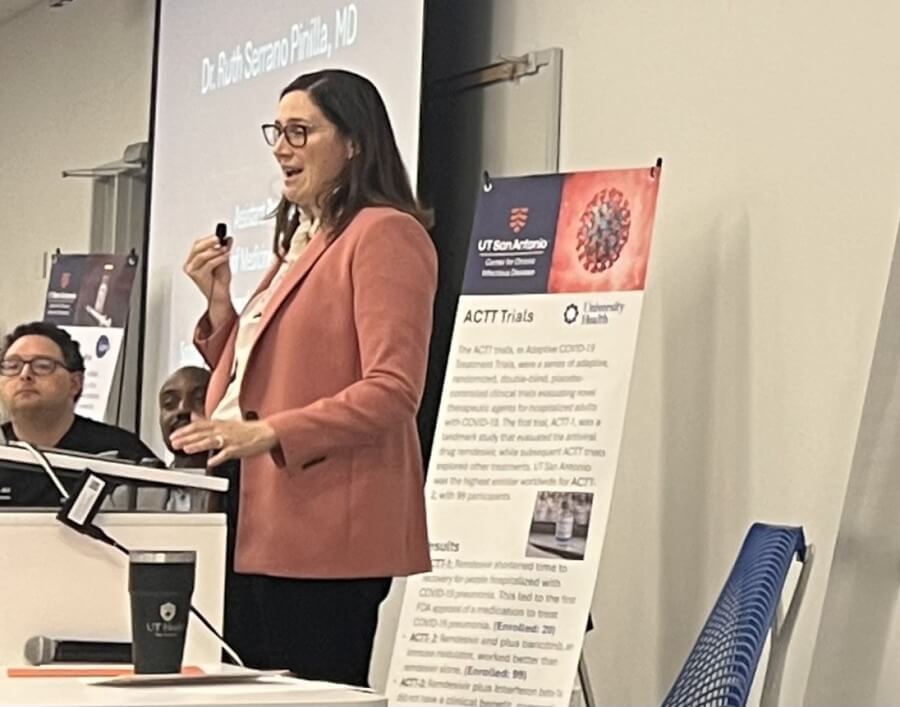
Ruth Serrano Pinilla, MD, assistant clinical professor in the Division of Infectious Diseases, described participation in the international STOMP trial evaluating tecovirimat for human monkeypox during the 2022 outbreak. Her team also supports HIV care through the AIDS Education and Training Center and the HIV ECHO platform, expanding provider expertise and strengthening the workforce.
“We’re committed to generating evidence and building the knowledge networks that improve care for people with HIV,” Serrano Pinilla said. “Research and education have to move forward together.”
A center built on collaboration
Closing the symposium, Taylor thanked presenters and advisory board members for shaping the center’s mission.
“Our work can benefit from being informed by you all,” she said. “I am deeply grateful you’re willing to do this work and help us be community responsive.”
The center will continue to host community-facing events, including partnerships with the university’s Be Well Institute on Substance Use and Related Disorders on the intersection of chronic infectious diseases and substance use disorders.
“We are here to help you write grants, enhance your scholarly output and build the collaborations you need,” Taylor said. “We want to help.”